Why Do Fasted Morning Workouts Affect PCOS Differently?
Quick Answer: Fasted morning exercise raises cortisol and relies on a well-functioning blood sugar response. Many people with PCOS have some degree of insulin resistance, and cortisol is already elevated for a meaningful subset — so fasted training can produce more post-exercise hunger, shakiness, and fatigue than it does for others. It is not universally unsuitable; it just needs a different test than the general advice assumes.
Everyone said to train fasted. You did, and you felt worse than when you ate first.
That is not a willpower problem.
This is general information, not medical advice.

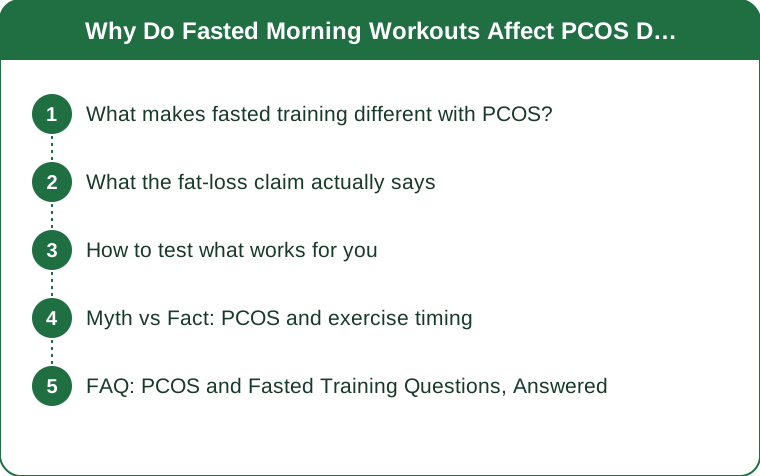
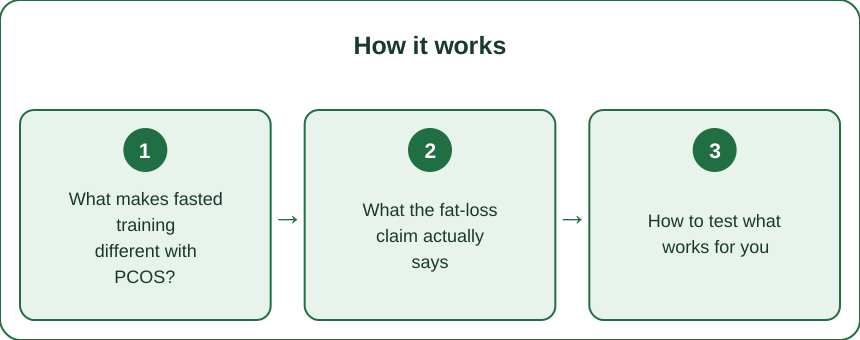
What makes fasted training different with PCOS?
Two features of PCOS interact with fasted exercise specifically.
Insulin resistance is common. A substantial proportion of people with PCOS have some degree of insulin resistance, and this is true across body sizes — lean PCOS included. Insulin resistance affects how readily glucose moves into muscle, and how stable blood sugar is across a demanding morning session on no food.
The practical experience of this is familiar to many people with PCOS: light-headedness, unusual weakness partway through a session, and disproportionate hunger for the rest of the day.
The cortisol picture is different for many. Exercise raises cortisol; that is normal and part of how training works. Fasted exercise raises it somewhat more, since low available fuel is itself a stressor. Research has found altered cortisol dynamics in some people with PCOS, and while the clinical picture varies considerably between individuals, it means the additional stress of fasted training is not landing on a neutral baseline for everyone.
Cortisol matters here because it influences blood glucose, appetite, and — over time — where the body stores fat.
Does this mean fasted training is bad for PCOS?
No. It means the general recommendation was not made with this hormonal context in mind, and the right answer is individual. Some people with PCOS train fasted comfortably; others clearly do better with food.
What the fat-loss claim actually says
It is worth being accurate here, because the fasted-training claim is widely overstated for everyone, PCOS or not.
Fasted exercise does increase the proportion of fat used as fuel during the session itself. That part is well established. What has not been established is that this translates into greater fat loss over weeks and months, once total energy intake is accounted for. Reviews comparing fasted and fed training generally find little to no meaningful difference in body composition outcomes when overall diet is matched.
What consistently does matter:
- Total energy balance over time.
- Total training volume and consistency, which is where fasted training can quietly lose ground — a session you complete at lower intensity because you have no fuel is a smaller training stimulus.
- Protein intake and resistance training, which are particularly relevant for PCOS given the metabolic benefits of muscle mass.
So the case for fasted training was never strong on fat loss grounds. For PCOS, where insulin sensitivity is a primary target and strength work is one of the better-supported interventions, protecting session quality is arguably the more important variable.
Is there any reason to train fasted then?
Convenience and preference are legitimate reasons. Some people simply feel better without food in them and sleep an extra twenty minutes as a result. That is a real benefit; it is just not a hormonal one.

How to test what works for you
This is answerable in about three weeks with a simple comparison.
Week 1 — fasted, and record honestly. Train as you normally would with nothing beforehand. After each session note: energy during, how the last third felt, hunger over the following four hours, and energy in the afternoon.
Week 2 — small carbohydrate and protein snack thirty to sixty minutes before. Something modest is enough. A banana with a spoonful of nut butter, yoghurt with fruit, half a slice of toast with egg. The aim is stable fuel, not a meal.
Week 3 — repeat whichever felt better to confirm it was not just a good or bad week.
What to look for:
- Session quality. Could you complete the planned work at the intended effort? This is the most important measure and the one people ignore in favour of how virtuous the session felt.
- The four hours after. Disproportionate hunger, a strong sugar craving, or an energy crash mid-morning are the clearest signs that fasted is not working for you.
- The afternoon. Fatigue that arrives around 3pm on training days but not rest days is worth noticing.
One practical adjustment that helps many people: keep easy sessions fasted if you prefer, and eat before hard or long ones. Intensity is where the fuel actually matters.
Does the type of exercise change the answer?
Yes. A gentle walk fasted is unproblematic for almost everyone. A heavy strength session or intervals is where the difference shows up most, and where eating first most often improves the outcome.
Myth vs Fact: PCOS and exercise timing
Myth: Fasted cardio burns more fat overall. Fact: It burns a higher proportion of fat during the session, and the evidence that this produces greater fat loss over time — when diet is matched — is weak. Total energy balance is what determines the outcome.
Myth: People with PCOS should avoid intense exercise because of cortisol. Fact: Vigorous exercise, including high-intensity work, has been shown to improve insulin sensitivity in PCOS. The question is fuelling and recovery around it, not avoiding it.
Myth: Cardio is the priority for PCOS. Fact: Resistance training has strong support for improving insulin sensitivity and body composition in PCOS, and it is frequently the underused half of the picture. A combination is generally recommended.
Myth: Eating before training undoes the workout. Fact: A small pre-training snack has no meaningful effect on whether training works. It affects how well you can train, which is the part that produces adaptation.
Myth: If fasted training makes you feel awful, you just need to adapt. Fact: Some adaptation occurs over a couple of weeks. Persistent light-headedness, weakness, or crashes after that point is information, not a phase to push through.
FAQ: PCOS and Fasted Training Questions, Answered
What should a pre-workout snack look like?
Something small combining carbohydrate with a little protein, taken thirty to sixty minutes ahead. Yoghurt and berries, a banana with nut butter, or a small bowl of oats all work. The size that leaves you comfortable rather than full is the right size.
Does this apply if I am on metformin?
Metformin affects blood glucose regulation, and how it interacts with fasted exercise varies. This is a good question for the clinician managing your treatment rather than one to work out by trial alone.
Is intermittent fasting bad for PCOS?
The evidence is mixed and still developing, with some small studies showing metabolic benefit and considerable individual variation. If you are already using it and feeling well, that is meaningful data. If you feel consistently worse, that is also meaningful data.
Why am I so much hungrier on days I train fasted?
Appetite regulation responds to both the energy deficit and the cortisol response. Higher hunger later in the day after fasted training is a common report, and it is one of the practical reasons the fat-loss argument often fails to materialize.
What is the single most useful change?
For most people with PCOS, adding or protecting resistance training two to three times a week outranks any decision about meal timing around it.
TL;DR:
- Fasted training raises cortisol and depends on stable blood sugar — both are relevant contexts in PCOS.
- Insulin resistance is common across all body sizes with PCOS, including lean PCOS.
- The fat-loss advantage of fasted cardio largely disappears once total intake is matched.
- Test it: one week fasted, one week with a small snack, and judge on session quality and the four hours afterward.
- Keep easy sessions fasted if you prefer; eat before hard ones.
The advice was not written with your hormonal context in mind. Three weeks of honest notes will tell you more than any general rule.
This is general information, not medical advice. PCOS management should be discussed with a clinician who knows your history.
Keep Reading
This article is for general informational purposes only and is not medical advice. Always consult a qualified health professional for guidance specific to you.