Why PCOS Makes Rest Days Feel Worse Than Training Days
Quick Answer: Exercise improves insulin sensitivity for roughly 24 to 48 hours afterwards. With PCOS, where insulin resistance is common, that window is doing meaningful work on blood sugar stability, energy, and mood. On a rest day the effect starts fading, and the swings return — which feels like the rest day caused it. The fix is not skipping rest, it is putting light movement on rest days to keep the window open.
Training days are fine. Not easy, but fine — steadier energy, fewer cravings, better mood by the evening.
Rest days are the ones that fall apart. You are hungrier, flatter, more irritable, and the afternoon is a slog. Which makes rest feel like the problem and training feel like the only thing holding it together.
That reading is understandable, and acting on it — training every day, never resting — is one of the more common ways PCOS management goes wrong.

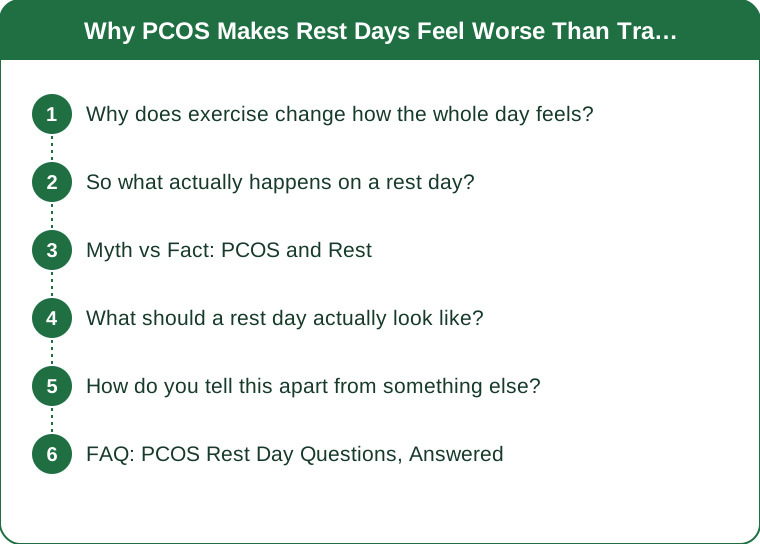
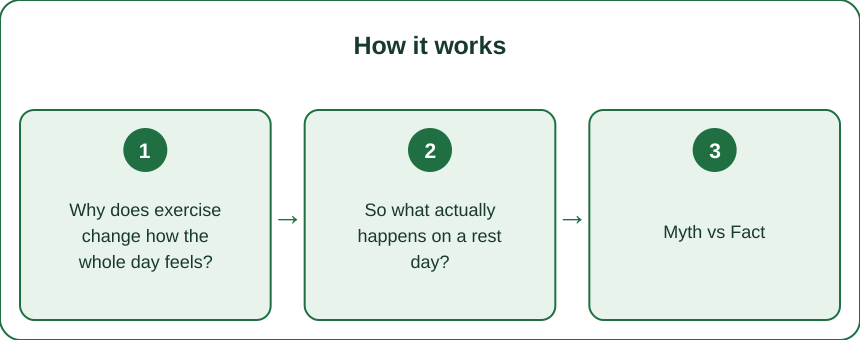
Why does exercise change how the whole day feels?
Because muscle contraction moves glucose without requiring insulin to do the work.
This is the key mechanism and it is worth being precise about. Muscle contraction triggers glucose uptake through a pathway that is independent of insulin. During and after exercise, your muscles pull glucose out of the bloodstream directly.
The effect outlasts the session. Improved insulin sensitivity persists for roughly 24 to 48 hours after a bout of exercise, with the largest benefit in the first 24. During that window, the same meal produces a smaller blood glucose rise and requires less insulin to manage.
Why that matters more with PCOS: insulin resistance is present in a substantial proportion of people with PCOS, across body sizes. When cells respond poorly to insulin, the body produces more of it, and higher circulating insulin contributes to several of the features of the condition.
What the post-exercise window feels like is what most people describe as a good day: steadier energy, fewer sharp hunger spikes, better concentration in the afternoon, more stable mood.
You are not imagining that training days are better. You are experiencing a real, temporary improvement in how your body handles fuel.
So what actually happens on a rest day?
The window narrows, and several things arrive at once.
Insulin sensitivity begins returning toward baseline, so the same breakfast produces a larger glucose rise and a larger subsequent fall. That fall is what the mid-morning slump and the strong hunger actually are.
Glucose disposal has no help. On a training day, a session in the afternoon clears some of the day’s load. On a rest day nothing does, so the swings are larger and more frequent.
The routine disappears. Training days usually have structure — a session time, a meal before, a meal after. Rest days often have less structure, and unstructured eating with fluctuating blood sugar produces exactly the grazing pattern that makes it worse.
Activity drops further than intended. A rest day frequently means not just no training but far fewer steps. Low-level movement throughout the day contributes meaningfully to glucose management, and losing it compounds the loss of the session.
The result is a day that feels flat, hungry, and long — and the obvious conclusion is that rest is the problem.
Myth vs Fact: PCOS and Rest
Myth: if training makes me feel better, more training is better. Fact: the insulin sensitivity benefit comes from regular bouts, not from maximising volume. Training every day without recovery raises cortisol and worsens sleep, both of which push insulin resistance the wrong way. Beyond a point, more training makes the condition harder to manage, not easier.
Myth: rest days are bad for PCOS. Fact: complete inactivity is unhelpful; rest from structured training is necessary. These are different things, and conflating them is the actual error.
Myth: the effect is about calories burned. Fact: the meaningful part is the insulin sensitivity window, not the energy expenditure. This is why a twenty-minute walk can noticeably change how a rest day feels despite burning very little.
Myth: cardio is what produces the benefit. Fact: both do, through partly different routes. Aerobic work produces a strong acute sensitivity effect; resistance training builds muscle mass, which increases the tissue available to store glucose long term. For PCOS specifically, resistance training tends to be the higher-value investment, and the evidence for it has strengthened considerably.
Myth: feeling worse on rest days means my plan is wrong. Fact: it usually means the plan is working on training days and the rest days have not been designed at all.

What should a rest day actually look like?
Rest from training, not from movement. That distinction is the entire answer.
The movement piece:
- A 10 to 15 minute walk after each main meal. This is the highest-value intervention available and it is well supported — post-meal walking blunts the glucose rise substantially, and it works precisely when you need it.
- A target of 6,000 to 8,000 steps across the day, without any structured session.
- Optional 15 minutes of easy mobility or stretching, which is genuinely restful and still counts as movement.
The structure piece, which matters as much:
- Keep meal timing the same as a training day. Unstructured eating is where rest days most often go wrong, and it is entirely avoidable.
- Protein at every meal, and particularly at breakfast. A protein-forward breakfast produces a much smaller glucose swing than a carbohydrate-heavy one, and it sets up the whole morning.
- Do not reduce food substantially because you did not train. Under-eating on rest days drives the afternoon crash and the evening overeating that follows it.
The sleep piece:
- Rest days are the best opportunity to protect sleep, and sleep quality has a direct effect on next-day insulin sensitivity. A rest day with poor sleep frequently produces the worst day of the week, and the sleep is doing more of that than the rest is.
A realistic weekly shape: three structured sessions, at least two of them resistance training, with 3 sets of 8 to 10 on compound movements. Rest days between them carrying walks and normal structure. That pattern maintains the sensitivity window across most of the week without training daily.
This is general information, not medical advice — if you have PCOS, your management should be discussed with your own clinician.
How do you tell this apart from something else?
The timing pattern is the most useful diagnostic, and there are things it is worth ruling out.
Consistent with the insulin sensitivity explanation: worse specifically on days without exercise, improves within an hour of a walk, tracks with meal composition, worst in the mid-morning and mid-afternoon, and better on rest days where you happened to be busy and on your feet.
Suggests something else: flatness present on training days too, no response to movement or food timing, present every day for weeks regardless of pattern, or accompanied by significant mood changes, sleep disruption, or loss of interest in things you normally enjoy.
Worth checking with a clinician: thyroid function, iron and ferritin, and vitamin D are all commonly involved in persistent fatigue and are all more frequently abnormal in people with PCOS. Iron deficiency in particular produces a very similar flat, effortful tiredness and is straightforward to test for.
Also worth reviewing: any medication changes, and where you are in your cycle if you have one — symptom severity commonly varies across it, and a rest day in one phase is not comparable to a rest day in another.
This is general information, not medical advice.
FAQ: PCOS Rest Day Questions, Answered
How many rest days should I take?
Most people do well with three to four structured sessions per week, meaning three to four rest days. The number matters less than what the rest days contain — a rest day with 7,000 steps and normal meals is a genuinely different thing from one with 1,500 steps and unstructured eating.
Is a post-meal walk really enough to notice?
For many people, yes, and the effect is more noticeable than the effort suggests. Ten to fifteen minutes after eating is the well-supported dose. It is the single easiest thing on this list and the one most likely to change how an afternoon feels.
Should I eat less on rest days?
Generally no, or only slightly. The difference in energy expenditure between a training day and a rest day is smaller than most people assume, and eating substantially less tends to produce an afternoon crash followed by evening overeating — which is worse for blood sugar stability than simply eating normally.
Does the time of day I train matter?
Some people with PCOS find morning training harder, which is a commonly reported pattern. Training later in the day is entirely fine and the sensitivity window works the same way. Consistency matters far more than timing.
TL;DR: Rest days feel worse because the exercise effect is wearing off, not because rest is bad.
- Exercise improves insulin sensitivity for 24 to 48 hours through an insulin-independent glucose uptake pathway.
- With PCOS, that window meaningfully steadies energy, hunger, and mood — so its fading is noticeable.
- Rest from training, not from movement. A 10 to 15 minute walk after each meal is the highest-value change.
- Keep meal timing and protein the same as a training day, and do not eat substantially less.
- Three to four sessions a week, at least two resistance-based, 3 sets of 8 to 10 on compounds.
If flatness is present on training days too and does not respond to movement, get thyroid, ferritin, and vitamin D checked rather than adding more training.
Keep Reading
This article is for general informational purposes only and is not medical advice. Always consult a qualified health professional for guidance specific to you.