Why PCOS Symptoms Shift When Your Sleep Schedule Does
Quick Answer: PCOS involves insulin resistance in a majority of cases, and insulin sensitivity is strongly circadian — the same meal produces a different glucose response depending on the time of day and on how well-slept you are. Short or irregular sleep reduces insulin sensitivity measurably within days, raises cortisol, and disrupts appetite hormones. So a schedule change with no dietary change can genuinely move symptoms. Sleep is not a soft lifestyle factor here; it is acting on the same pathway as everything else you are managing.
It feels like the symptoms are arbitrary. They usually are not.
The variable most people are not tracking is the one that moved.

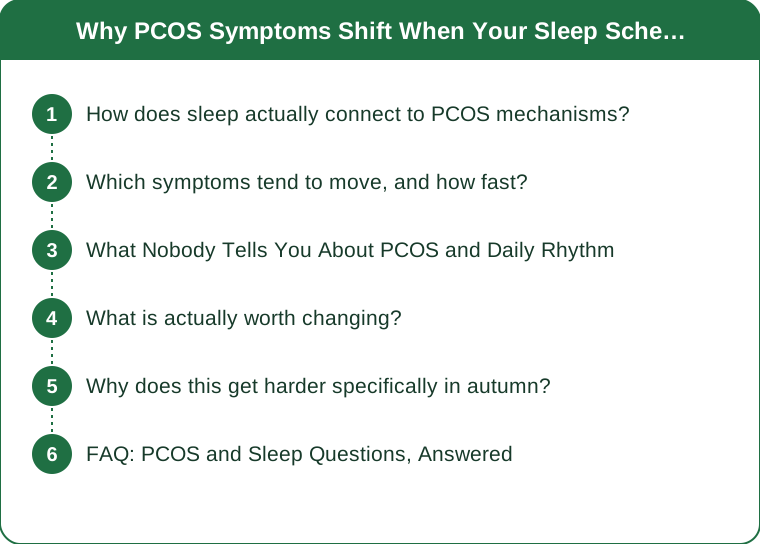
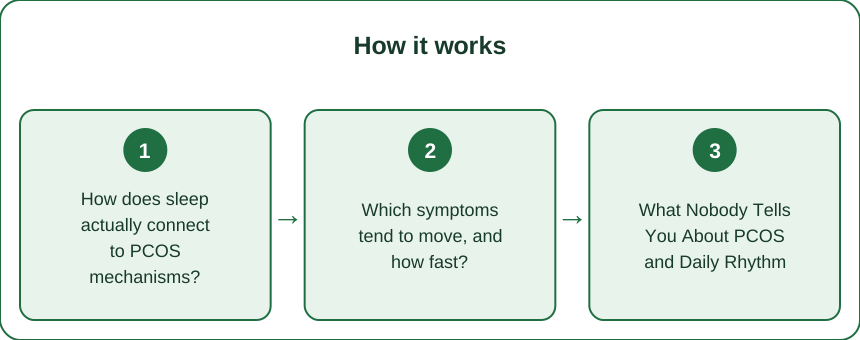
How does sleep actually connect to PCOS mechanisms?
Through insulin, primarily, with cortisol and appetite hormones adding to it.
Insulin resistance is central to PCOS for a large proportion of people — commonly cited as affecting most individuals with the condition, and independent of body weight. Higher circulating insulin drives increased androgen production from the ovaries and reduces sex hormone binding globulin, which raises free testosterone. That pathway underlies several of the symptoms people find most difficult.
Now the sleep connection:
Short sleep reduces insulin sensitivity quickly. Controlled studies restricting healthy adults to four to five hours a night have found measurable reductions in insulin sensitivity within a week — in some studies within days. That is a change in the exact mechanism PCOS management targets, produced without touching food.
Sleep loss raises cortisol, particularly in the evening. Cortisol raises blood glucose and increases insulin demand, adding to the same load.
Appetite hormones shift. Sleep restriction reliably lowers leptin and raises ghrelin, which increases hunger and specifically increases preference for higher-carbohydrate, higher-calorie food. So the schedule change also makes the dietary side harder, which compounds it.
And circadian misalignment matters separately from duration. Eating at times misaligned with your body clock produces a worse glucose response than the same food eaten in alignment — this is well demonstrated in shift-work research. You can sleep eight hours and still be misaligned if the timing is irregular.
Is sleep apnoea relevant here?
Very. Obstructive sleep apnoea is substantially more common in PCOS than in the general population, and it worsens insulin resistance independently. If you snore, wake unrefreshed, or have daytime sleepiness despite adequate hours, this is worth raising with a doctor — it is frequently missed.
Which symptoms tend to move, and how fast?
The pattern people report, roughly in the order it appears:
Within days: energy, carbohydrate cravings and mood. These track the acute insulin and appetite hormone changes, and they are the fastest to move in both directions.
Within one to three weeks: skin changes, for some people. Sebum production responds to androgen levels, and the lag is real but not long.
Over one to three months: cycle regularity. Ovulation timing responds to the hormonal environment over a longer window, so a schedule change in September may show up in a cycle in November. This lag is the main reason people do not connect the two.
Variable: hair changes, which operate on hair growth cycles measured in months and are the slowest of all to respond to anything.
What this means practically: if you are trying to evaluate whether a change helped, the timescale has to match the symptom. Judging cycle effects after two weeks tells you nothing, and abandoning a change at that point is common and unfortunate.
It also means the reverse. A rough few weeks of sleep in August can plausibly show up as a symptom flare in October, long after the sleep has been corrected and the connection has been forgotten.
What Nobody Tells You About PCOS and Daily Rhythm
Regularity may matter as much as duration. A consistent seven hours often serves people better than an erratic eight, because circadian alignment depends on consistent timing signals. Sleeping in for three hours at the weekend produces a form of misalignment sometimes called social jetlag, and it has been associated with worse metabolic markers.
Meal timing is part of the same system. Insulin sensitivity is generally higher earlier in the day. A large late meal is metabolically more expensive than the same meal earlier, which is a low-effort change that requires no change to what you eat at all.
Morning light is a treatment, not a wellness suggestion. Light exposure shortly after waking is the primary signal that sets circadian timing. Ten to twenty minutes outdoors in the morning is one of the few interventions here that is free, evidence-supported and immediately available.
Evening light does the opposite, and screens are not the main problem. Bright overhead room lighting in the two hours before bed suppresses melatonin substantially. Dimming the room matters more than the blue-light filter on your phone.
Exercise timing interacts with this. Intense training late in the evening raises core temperature and arousal and delays sleep onset in many people. If your training moved later and your sleep got worse, that is a plausible chain.
Caffeine has a longer reach than most people assume. Its half-life is roughly five to six hours, so a 3pm coffee still has meaningful levels at 9pm. Where sleep is a treatment lever, a caffeine cutoff earlier in the day is not fussy — it is part of the intervention.
And the unfair part, said plainly: PCOS makes sleep harder as well as being affected by it. Higher androgens, anxiety and apnoea risk all interfere with sleep quality. This is a genuine loop rather than a willpower issue, and it is worth naming so you are not blaming yourself for the harder half.

What is actually worth changing?
In order of impact relative to effort:
- Fix the wake time first, not the bedtime. A consistent wake time anchors circadian rhythm and the bedtime follows. Trying to fix bedtime directly rarely works.
- Get outside within an hour of waking, for ten to twenty minutes, most days. This is the highest-value single change on the list.
- Move your largest meal earlier, and avoid a large meal within about three hours of bed. No change to content required.
- Set a caffeine cutoff around eight hours before bed. For a 10:30pm bed, that is roughly 2:30pm.
- Dim the overhead lights in the last hour or two. Lamps rather than ceiling lights.
- Keep weekend timing within about an hour of weekdays. The catch-up lie-in costs more than it returns.
- Move intense training earlier if it currently lands within three hours of bed.
- Get apnoea assessed if there is snoring, witnessed pauses in breathing, or daytime sleepiness. This is the one item on the list that needs a doctor and it is the one with the largest potential effect.
Give it eight to twelve weeks before judging cycle effects, and track something simple — sleep timing, energy, cycle dates — so you can actually see whether it moved.
PCOS is a medical condition and management should be led by your doctor or specialist. This is general information, not medical advice, and it is not a substitute for treatment. If symptoms change or worsen, speak to your healthcare provider.
Why does this get harder specifically in autumn?
Because the seasonal transition attacks circadian rhythm directly, and it is starting now.
Morning light disappears fastest around the equinox. Through September and October, sunrise moves later at close to its maximum annual rate. The morning light signal that anchors your rhythm gets weaker and later, precisely when you most need it stable.
For many people this produces a gradual drift toward later sleep timing — waking later, going to bed later, and slowly falling out of alignment without any decision having been made.
Evening habits shift too. Darker evenings mean more indoor time under bright artificial light, later meals, and less outdoor activity. All three push in the same direction.
And mood and energy dip for a meaningful share of people as light falls, which affects motivation for the routines that were holding things together.
What to do about it over the next several weeks:
- Protect the wake time hard through the transition. This is the anchor, and it is the thing that drifts first.
- Prioritise morning outdoor light even when it is grey. Overcast daylight is still far brighter than indoor lighting — usually by an order of magnitude or more.
- Consider whether a morning light lamp is worth it if you leave for work before dawn. For people whose symptoms track their schedule, it can be a reasonable option to discuss with a doctor.
- Plan for the clock change rather than absorbing it. Shifting bedtime by 15 minutes over several days is easier than a one-hour jump.
- Expect that a September schedule wobble may show up in an October or November cycle, and do not read the delay as the change not working.
Is winter worse for PCOS symptoms generally?
Evidence on seasonality specifically in PCOS is limited. What is better established is that circadian disruption worsens insulin sensitivity, and autumn is a period of circadian disruption for most people. That is enough reason to protect the routine.
FAQ: PCOS and Sleep Questions, Answered
How much sleep should I actually be getting?
General adult guidance is seven to nine hours. For someone managing insulin resistance, consistently landing at the lower end is likely costing you something.
Will fixing sleep replace my medication?
No. It is a factor that acts on the same pathway, not a substitute for treatment. Any change to prescribed medication is a decision for your doctor.
Does napping help?
A short nap early in the afternoon can help acute tiredness without much cost. Long or late naps push bedtime later and worsen the underlying alignment problem.
Why do I get intense cravings after a bad night?
Sleep restriction lowers leptin and raises ghrelin, and specifically increases preference for high-carbohydrate food. It is a hormonal response, not a lapse.
Is melatonin a good idea?
Worth discussing with your doctor rather than starting independently. Timing and dose matter considerably, and it interacts with the wider picture.
Should I track my cycle against my sleep?
Yes — it is the cheapest way to see a relationship that operates on a one-to-three-month lag, and it gives your doctor useful information.
TL;DR:
- PCOS commonly involves insulin resistance, and insulin sensitivity falls measurably with short or irregular sleep — within days in controlled studies.
- Sleep loss also raises cortisol and shifts appetite hormones, compounding the same pathway.
- Regularity matters as much as duration. Weekend catch-up sleep creates its own misalignment.
- Symptoms move on different timescales — energy in days, skin in weeks, cycles in months. Judge accordingly.
- Fix the wake time first, get morning daylight, move the biggest meal earlier, set a caffeine cutoff.
- Sleep apnoea is more common in PCOS and frequently missed — worth asking about.
- Autumn removes the morning light signal fastest of any time of year, so protect the routine now.
This is general information, not medical advice — PCOS management should be led by your healthcare provider.
The symptoms were not random. They were tracking the one variable nobody writes down.
Keep Reading
This article is for general informational purposes only and is not medical advice. Always consult a qualified health professional for guidance specific to you.