For PCOS, the Type of Exercise Matters More Than How Much You Do
Quick Answer: For PCOS, strength training and moderate movement tend to support insulin sensitivity better than long steady cardio alone — excessive high-intensity cardio can even raise cortisol in a way that works against symptom management. This is general information, not medical advice.
You’ve been told ‘just exercise more’ for your PCOS symptoms, and you have — hours of cardio, little to show for it. The missing piece usually isn’t effort. It’s exercise type.

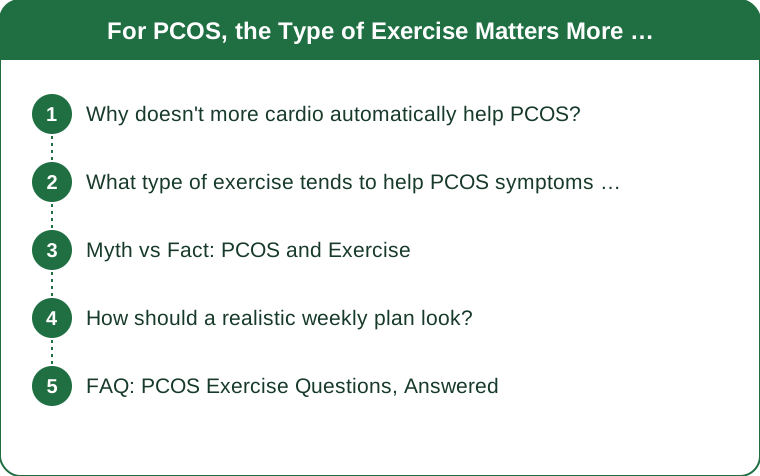
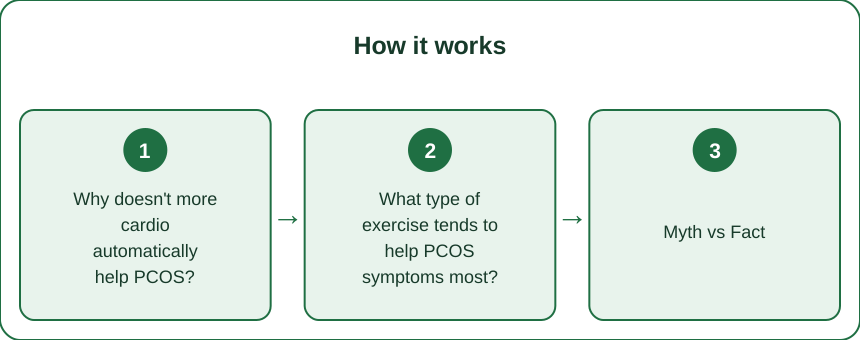
Why doesn’t more cardio automatically help PCOS?
Because PCOS symptoms are heavily tied to insulin resistance, and excessive high-intensity or prolonged cardio can raise cortisol, which works against insulin sensitivity in some people. More isn’t inherently better here the way it might be for pure weight-loss goals — the metabolic picture is more specific.
What type of exercise tends to help PCOS symptoms most?
Resistance training 2-3x a week builds muscle, which is one of the body’s primary sites for glucose uptake — more muscle generally means better insulin sensitivity. Pair it with moderate cardio (brisk walking, cycling) rather than daily high-intensity sessions, which can add unhelpful cortisol load on top of an already dysregulated system.

Myth vs Fact: PCOS and Exercise
Myth: HIIT is always the best fat-loss tool for PCOS. Fact: For some, frequent intense HIIT raises stress hormones enough to counteract the benefit — 2-3x a week max, balanced with strength and walking, tends to work better than daily HIIT.
Myth: You need to exercise 6 days a week to see PCOS improvement. Fact: Consistency at 3-4 quality sessions a week (strength-focused) shows real results in research — more isn’t automatically more effective here.
Myth: Cardio alone will fix insulin resistance. Fact: Muscle tissue built through resistance training plays a direct role in glucose regulation that cardio alone doesn’t replicate.
How should a realistic weekly plan look?
2-3 strength sessions (full body, moderate weight, 8-12 reps), 2 moderate cardio sessions (30 minute brisk walk or easy cycle), and 1-2 rest or gentle movement days (yoga, stretching). This isn’t about grinding harder — it’s about matching the movement type to what actually helps the underlying hormonal picture.
FAQ: PCOS Exercise Questions, Answered
Is walking enough exercise for PCOS?
Walking is genuinely helpful and low-stress on the system, but pairing it with 2x weekly strength training tends to show better metabolic results than walking alone.
Can too much exercise make PCOS symptoms worse?
Yes — excessive high-intensity training without adequate recovery can raise cortisol and worsen the exact hormonal imbalance you’re trying to improve.
Should I see a professional before changing my exercise routine for PCOS?
If you have significant symptoms or are on medication, checking with a doctor or PCOS-informed dietitian before major changes is a reasonable step — this article is general information, not a substitute for individual medical advice.
TL;DR:
- PCOS responds better to exercise type-matching than to raw volume
- Resistance training 2-3x/week supports insulin sensitivity directly through muscle
- Excess high-intensity cardio can raise cortisol and work against symptoms
- Balance strength, moderate cardio, and rest — not daily high intensity
This is general information, not medical advice — work with a professional for your specific case.
Keep Reading
This article is for general informational purposes only and is not medical advice. Always consult a qualified health professional for guidance specific to you.