PCOS and Exercise: Why Strength Training Might Matter More Than Your Cardio Habit
Quick Answer: Strength training improves insulin sensitivity more directly than steady-state cardio for most women with PCOS, because muscle tissue is where a large share of glucose gets absorbed after a workout — more muscle worked means more places for that glucose to go.
You’ve probably been told to “just move more” for PCOS. But not all movement pulls the same lever, and if insulin resistance is part of your picture, the type of exercise you choose matters as much as whether you do it at all.

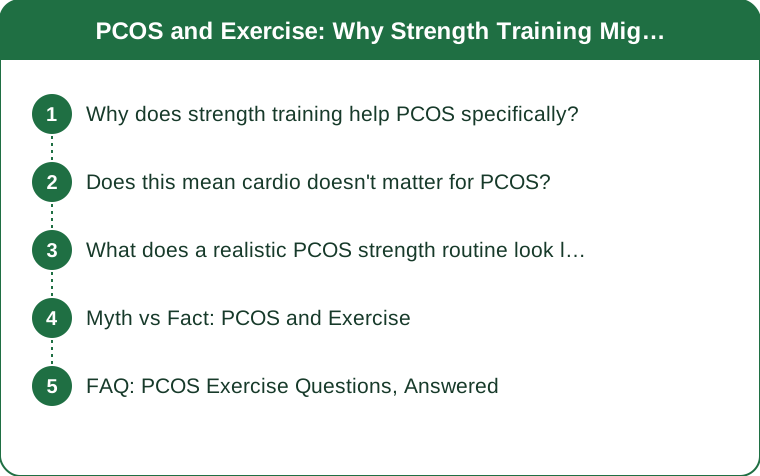
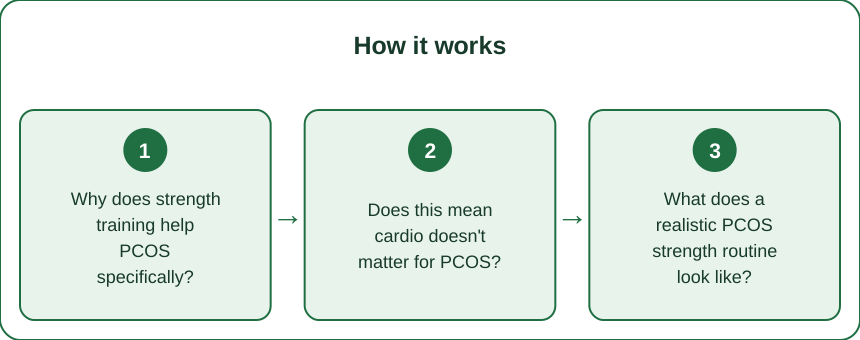
Why does strength training help PCOS specifically?
PCOS is frequently tied to insulin resistance, where your cells don’t respond well to insulin’s signal to absorb glucose. Resistance training recruits large muscle groups that soak up glucose independent of insulin, through a separate pathway triggered by muscle contraction itself. Cardio helps too, but strength work adds this second glucose-clearing route that steady jogging doesn’t activate as strongly.
Does this mean cardio doesn’t matter for PCOS?
No — cardio still supports heart health and can help with weight management, which matters for PCOS symptom severity. Think of it as complementary rather than competing: two to three strength sessions a week plus two cardio sessions covers more ground than either alone.

What does a realistic PCOS strength routine look like?
Full-body sessions two to three times a week, focused on compound moves like squats, rows, and presses, 8-12 reps for 3 sets, is enough to see insulin sensitivity improvements within about eight weeks in most studies. You don’t need to lift heavy immediately — consistency matters more than load in the first month.
Myth vs Fact: PCOS and Exercise
Myth: You need to exercise for an hour a day to see PCOS benefits. Fact: Studies showing insulin sensitivity improvements often use 30-45 minute sessions, 3-4 times a week — duration matters less than consistency.
Myth: Lifting weights will make PCOS-related weight gain worse. Fact: Building muscle raises your resting metabolic rate, which works in your favor for weight management, not against it.
Myth: Cardio is the only exercise that helps hormones. Fact: Resistance training has shown comparable or better effects on insulin markers in several head-to-head studies.
FAQ: PCOS Exercise Questions, Answered
Is high-intensity interval training safe with PCOS?
For most women, yes — HIIT has shown strong insulin sensitivity benefits in PCOS studies, though it’s worth starting with 1-2 sessions weekly and monitoring how your energy responds.
How soon will I notice a difference?
Many women report more stable energy and less afternoon crashing within 3-4 weeks, though hormonal markers typically take 8-12 weeks to shift measurably.
Should I avoid cardio entirely and only lift?
No — a mix works best. Lean toward strength if you have to pick one, but don’t cut cardio out completely.
TL;DR:
- Strength training activates a glucose-clearing pathway that doesn’t depend on insulin, which is useful when insulin resistance is part of PCOS
- Aim for 2-3 full-body strength sessions weekly, 8-12 reps, 3 sets
- Combine with cardio rather than replacing it entirely
- Expect energy improvements in weeks, hormonal markers to shift over months
This is general information, not medical advice — talk with your doctor about how exercise fits your specific PCOS presentation before making major changes.
Keep Reading
This article is for general informational purposes only and is not medical advice. Always consult a qualified health professional for guidance specific to you.