Why PCOS Can Make Morning Workouts Harder Than Evening Ones
Quick Answer: Many people with PCOS find morning training disproportionately hard because insulin sensitivity tends to be lowest in the early morning, the natural cortisol peak lands at the same time, and sleep quality is more frequently disrupted, so you arrive at a morning session already under-recovered and with less usable fuel. Evening or late afternoon sessions frequently feel easier and produce better output. If mornings are the only option, eating something before training and warming up longer closes most of the gap.
You set the alarm, you got up, you did the thing you had planned, and it felt roughly twice as hard as it did on Tuesday evening.
This pattern comes up constantly and it is usually filed as a motivation problem. There are at least three physiological reasons it might not be.

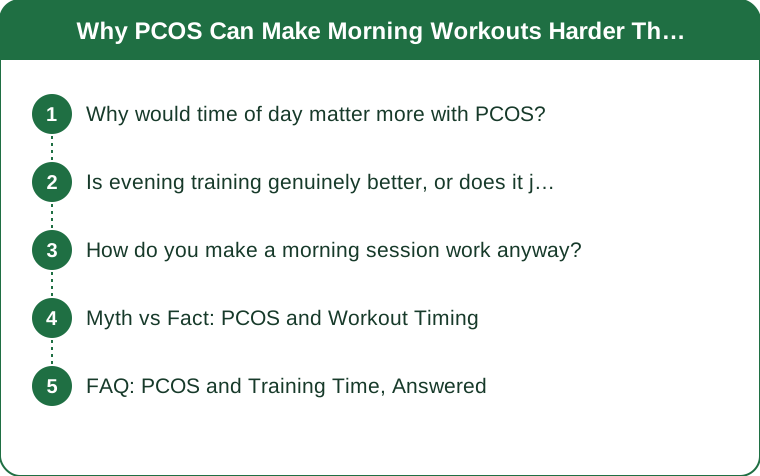
Why would time of day matter more with PCOS?
Because several of the things that vary across the day are the specific things PCOS affects.
Insulin sensitivity follows a daily rhythm. In most people, insulin sensitivity is higher earlier in the waking day for meals and declines later. But there is a separate and well-described phenomenon in the very early morning, sometimes called the dawn effect, where a rise in cortisol and growth hormone before waking pushes blood glucose up and reduces insulin sensitivity. Insulin resistance is a central feature of PCOS for a large proportion of people who have it, so an effect that is mild for most is amplified.
Cortisol peaks shortly after waking. The cortisol awakening response is normal and useful. It is also a stress signal, and adding a demanding training session on top of an already elevated cortisol state produces a higher total load than the same session later in the day.
Sleep disruption is more common with PCOS. Sleep-disordered breathing and poor sleep quality are more prevalent in PCOS, independent of body weight in many studies. Arriving at a morning session on genuinely poor sleep is a different proposition from arriving at an evening one after a normal day.
Core body temperature is lowest in the early morning. This is true for everyone. Muscle function, joint mobility, and perceived exertion are all worse at low body temperature, which is why early sessions require a longer warm-up in general.
These stack rather than add. Lower insulin sensitivity plus higher cortisol plus poorer sleep plus a cold body is a meaningfully different starting state, and it explains a gap that feels much too large to be explained by the clock alone.
This is general information, not medical advice. PCOS presents very differently between people, and a doctor or a specialist dietitian is the right place for individual guidance.
Is evening training genuinely better, or does it just feel better?
Both, in most of the available evidence, with an important caveat.
Performance is generally higher in the late afternoon and early evening. Core body temperature peaks in that window, and strength, power, and endurance performance tend to follow. This is a robust finding across the general population and not specific to PCOS.
Glucose handling may benefit from afternoon and evening activity. Research on exercise timing and metabolic health has found favourable effects for afternoon and evening activity on insulin sensitivity and glucose control in people with insulin resistance. The evidence base is still developing and the effect sizes are modest, and the direction is consistent enough to be worth knowing.
The important caveat is sleep. High intensity training close to bedtime interferes with sleep for some people, and sleep quality matters enormously for PCOS symptom management. Finishing hard sessions at least two to three hours before bed avoids most of this, and individual sensitivity varies a lot.
The most practical framing. The best time to train with PCOS is the time you will actually train consistently. A morning session you do four times a week beats an evening session you do once. The point of this article is not to move everyone to evenings, it is to explain why mornings feel harder so that you stop reading it as a personal failure.
If mornings are your only realistic slot, they are the right choice. The next section is about making them work.

How do you make a morning session work anyway?
Four adjustments, and the first one does most of the work.
1. Eat something first. This is the single biggest change. Fasted morning training is popular and it is a poor fit for a low insulin sensitivity, high cortisol starting state, and this blog has covered why fasted cardio is generally not the right default with PCOS. Something small with protein and carbohydrate 30 to 60 minutes before is enough: yoghurt and fruit, toast with nut butter, a small smoothie. You are not eating a meal, you are changing the starting conditions.
2. Warm up twice as long as you think you need. Ten to fifteen minutes of gradually rising intensity, rather than three. The first part of a morning session is being done with a cold body and stiff joints, and rushing it accounts for a large share of why the session feels bad. This blog has noted elsewhere that the warm-up is where problems show up first.
3. Put the strength work first and the conditioning second. If insulin sensitivity and energy availability are limited, spend them on the work with the highest return. Strength training has particularly strong evidence for improving insulin sensitivity in PCOS, and it tolerates a lower-fuel state better than sustained high intensity conditioning does.
4. Do not judge the session by the first ten minutes. The gap between how a morning session starts and how it ends is far larger than in the evening. Many people find that if they get through the warm-up, the session is entirely normal. Deciding at minute four is deciding at the worst possible moment.
And protect sleep, because it changes everything upstream. A morning session after seven hours of sleep is a different session than the same one after five. If mornings are non-negotiable, bedtime becomes the lever.
Myth vs Fact: PCOS and Workout Timing
Myth: Morning workouts are better for blood sugar. Fact: For insulin resistance specifically, afternoon and evening activity has at least as much support, and possibly more. The early morning is when insulin sensitivity is at its lowest for many people, which is the opposite of the popular assumption.
Myth: Fasted morning cardio burns more fat and is better for PCOS. Fact: Fasted training shifts which fuel you use during the session, and does not reliably improve body composition outcomes over time. Combined with elevated morning cortisol and lower insulin sensitivity, it is a poor default here.
Myth: If mornings feel hard, you are just not a morning person. Fact: Chronotype is real and it is not the whole story. Cortisol timing, the dawn effect on glucose, low core temperature, and PCOS-associated sleep disruption are all measurable and all point the same way.
Myth: Evening exercise ruins your sleep. Fact: For most people, moderate exercise in the evening does not harm sleep and often improves it. High intensity work in the last hour or two before bed is the version that causes problems, and finishing two to three hours before bed avoids it.
Myth: You should train hard every session to make progress with PCOS. Fact: Consistency and strength work matter far more than intensity, and this blog has covered why exercise type matters more than amount. Pushing a bad morning session to failure has a poor return relative to its recovery cost.
Myth: The day-to-day variation means something is wrong. Fact: Workout difficulty varying substantially between days is a well-recognised PCOS experience and has been covered here before. Time of day is one more input into that variation, not evidence of a problem.
FAQ: PCOS and Training Time, Answered
Why are morning workouts so much harder with PCOS?
Insulin sensitivity is typically lowest in the early morning, the natural cortisol peak lands at the same time, core temperature is at its lowest, and sleep disruption is more common with PCOS. Those four things stack into a genuinely different starting state.
Is it better to exercise in the evening if I have PCOS?
Often, yes, for performance and possibly for glucose handling. The main caveat is finishing hard sessions two to three hours before bed so sleep is not affected. The best time overall is still the one you will do consistently.
Should I eat before a morning workout with PCOS?
Generally yes. Something small with protein and carbohydrate 30 to 60 minutes beforehand changes the starting conditions considerably. Fasted training is a poor default when insulin sensitivity is already low and cortisol is already high. This is general information, not medical advice.
TL;DR:
- Morning sessions are harder with PCOS because low early-morning insulin sensitivity, peak cortisol, low body temperature, and disrupted sleep stack together.
- Late afternoon and evening training generally produces better performance, with some support for better glucose handling too.
- If mornings are your slot, eat something first, warm up for ten to fifteen minutes, and put strength work first.
- Do not judge a morning session at minute four. The gap between the start and the end is much wider than in the evening.
Try eating something small before your next morning session and see how much of the difficulty was fuel rather than willpower.
Keep Reading
This article is for general informational purposes only and is not medical advice. Always consult a qualified health professional for guidance specific to you.