Why PCOS Sleep Quality Changes What Your Workout Can Do the Next Day
Quick Answer: Poor sleep reduces insulin sensitivity for the following day in everyone - but PCOS often involves baseline insulin resistance, so the same sleep loss lands on a system with less margin. Add a substantially higher rate of sleep apnoea in PCOS, plus elevated cortisol from short sleep, and a bad night changes how you tolerate carbohydrate, how hard a session feels, and how well you recover. Which is why sleep is a training variable with PCOS, not a lifestyle side note.
And it explains one of the most common frustrations: doing everything the same and getting a completely different day.

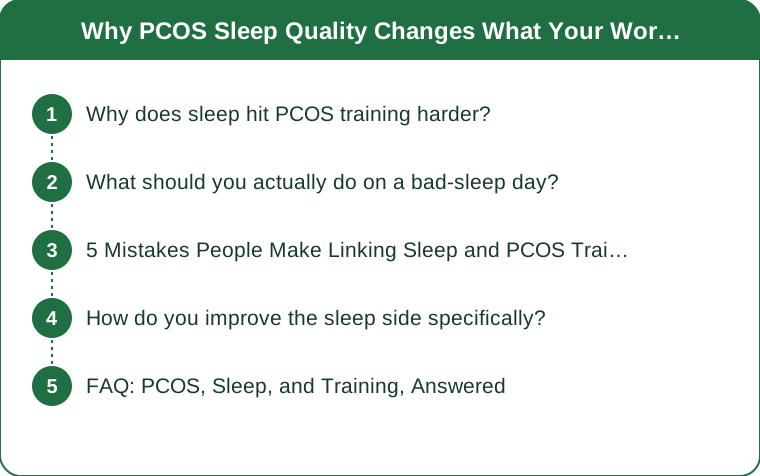
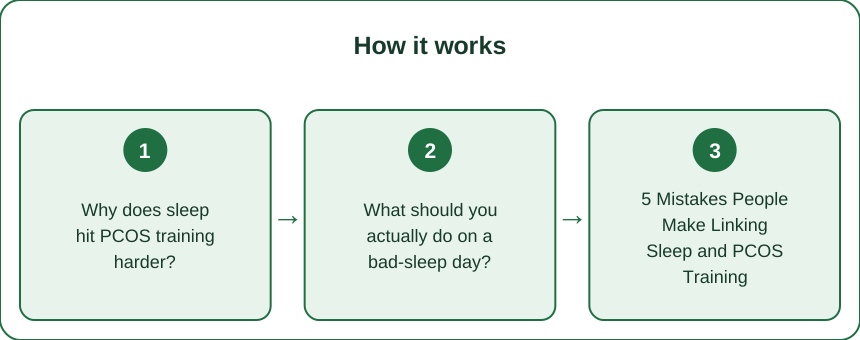
Why does sleep hit PCOS training harder?
Because the mechanisms stack on a system that already has less headroom.
Short sleep reduces insulin sensitivity measurably, in healthy people, after a single night. The effect is well documented. If your baseline insulin sensitivity is already reduced - as it is for many people with PCOS - the same percentage drop leaves you in a meaningfully worse position than it would someone starting from a higher baseline.
Cortisol rises with sleep restriction, and elevated cortisol both opposes insulin and increases appetite for quickly available energy. The 3pm craving after a bad night is a hormonal event, not a discipline failure.
Sleep apnoea is substantially more common in PCOS than in the general population of similar body weight - it is one of the more under-recognised associations. Apnoea fragments sleep without waking you fully, so you can spend eight hours in bed and get a night’s worth of restoration from considerably less.
And recovery capacity drops. Growth hormone release is concentrated in early-night deep sleep. Less deep sleep means less of the repair signalling that turns a training session into an adaptation - so you take the fatigue and get less of the benefit.
The practical consequence: on a poor-sleep day, the same session costs more and returns less. That is worth planning around rather than pushing through.
What should you actually do on a bad-sleep day?
Change the session, not the commitment.
Keep the session, downgrade the intensity. Moving a planned high-intensity day to a walk, a mobility session, or easy resistance work preserves the habit and removes the cost you cannot afford. Skipping entirely tends to break the routine; downgrading does not.
Favour resistance over high-intensity cardio on those days. Moderate resistance training is generally better tolerated after poor sleep than an all-out interval session, and for PCOS specifically, resistance training has a strong case as the priority modality anyway - improving insulin sensitivity through increased muscle mass and glucose uptake.
Move the session later if you can. Many people with PCOS report morning sessions being disproportionately harder, and after a bad night that gap widens. Late morning or afternoon is often substantially more productive.
Eat before training rather than fasted. Fasted training after poor sleep stacks two stressors. Some protein and carbohydrate beforehand makes the session more productive and reduces the post-session crash.
And protect the walk. If one thing survives a bad night, make it a 10 to 15 minute walk after your largest meal. Post-meal walking has consistent evidence for blunting glucose response, and it is the highest-value, lowest-cost intervention available on a day when nothing else is going well.

5 Mistakes People Make Linking Sleep and PCOS Training
1. Treating a bad session as a fitness problem. It is usually a recovery problem. Adding more training in response is exactly backwards and produces the cycle of increasing effort with decreasing results that is so common in PCOS forums.
2. Ignoring snoring and daytime sleepiness. Sleep apnoea is meaningfully more common in PCOS and is treatable. Persistent daytime sleepiness, snoring, waking with a headache, or a partner noticing pauses in breathing all warrant a conversation with a doctor - and treating it changes everything downstream.
3. Using caffeine to bridge the gap. It works for the session and costs the following night, which starts a self-sustaining cycle. A cutoff around eight hours before bed is the single most effective sleep intervention most people have not tried.
4. Fasted morning cardio after poor sleep. Two stressors compounding, and often the specific combination behind mid-morning crashes and intense afternoon cravings.
5. Judging progress on the scale during a bad-sleep stretch. Poor sleep affects fluid retention, appetite, and cortisol - none of which are fat mass. Strength numbers and how sessions feel are far better progress markers with PCOS anyway.
The second one is the most consequential: it is common, treatable, and routinely missed, and treating it improves both training and metabolic markers.
This is general information, not medical advice.
How do you improve the sleep side specifically?
The interventions with the best evidence, in rough order of impact.
Fix the wake time before the bedtime. A consistent wake time is a stronger circadian anchor and much more controllable. Consistency matters more than duration for how a night actually functions.
Get bright light within an hour of waking. Ten to fifteen minutes outdoors. This anchors the rhythm at the front and improves sleep onset that night far more reliably than anything done in the evening.
Move the caffeine cutoff earlier. Caffeine has a long half-life and individual sensitivity varies widely. Eight hours before bed is a reasonable starting point, and the change often takes a week to show.
Train, but not too late and not too hard too late. Regular exercise improves sleep quality substantially. Vigorous sessions finishing within 90 minutes of bed do the opposite - keep hard work earlier where possible.
Address blood sugar in the evening. A large, carbohydrate-heavy late meal can produce overnight glucose swings that fragment sleep. A balanced evening meal with protein, and finishing eating a couple of hours before bed, helps some people noticeably.
Get screened for apnoea if any of the signs are present. This is not a lifestyle adjustment - it is a medical question with a treatment, and it is the highest-leverage item on this list for anyone it applies to.
And be realistic about the direction of causation. Better sleep improves insulin sensitivity, and better insulin sensitivity improves sleep. The loop runs both ways, which means small improvements compound - a genuinely encouraging feature of an otherwise frustrating system.
This is general information and not medical advice. PCOS management, sleep disorders, and medication decisions should be discussed with your doctor.
FAQ: PCOS, Sleep, and Training, Answered
Does one bad night really change my workout?
A single night of restricted sleep measurably reduces insulin sensitivity the following day and raises cortisol. With PCOS, that lands on a system with less baseline margin, so the effect is more noticeable.
Should I skip training after a bad night?
Usually downgrade rather than skip. Moderate resistance work or a walk preserves the routine and avoids the cost of a hard session you will not recover from well.
Why are morning workouts harder with PCOS?
Many people report this, and morning cortisol patterns and blood glucose regulation are plausible contributors. If mornings are consistently worse for you, training later is a reasonable and legitimate adjustment.
Is sleep apnoea really more common with PCOS?
It is recognised as substantially more common in PCOS than would be expected from body weight alone. If you snore, wake unrefreshed, or feel sleepy during the day, it is worth raising with your doctor.
Does exercise improve PCOS sleep?
Regular exercise generally improves sleep quality, provided vigorous sessions are not too close to bedtime. Resistance training in particular has good support for PCOS more broadly.
Should I train fasted with PCOS?
Many people find fasted training harder to tolerate, particularly after poor sleep. Eating some protein and carbohydrate beforehand usually produces a better session and a steadier afternoon.
TL;DR:
- One short night reduces insulin sensitivity and raises cortisol - and with PCOS that lands on a system with less baseline margin.
- Sleep apnoea is substantially more common in PCOS and is treatable; snoring, unrefreshing sleep, or daytime sleepiness is worth raising with a doctor.
- Less deep sleep means less of the repair signalling that converts a session into an adaptation.
- On a bad night: downgrade rather than skip, favour resistance over intervals, train later, eat beforehand, and protect the post-meal walk.
- Sleep fixes with the best return: consistent wake time, morning light, earlier caffeine cutoff, no hard sessions close to bed.
The loop runs both ways - better sleep improves insulin sensitivity and better insulin sensitivity improves sleep. Small changes compound, which is the encouraging part.
This is general information, not medical advice.
Keep Reading
This article is for general informational purposes only and is not medical advice. Always consult a qualified health professional for guidance specific to you.