Why PCOS Strength Gains Show Up Months Before the Scale Does
Quick Answer: With PCOS, strength training improves insulin sensitivity and body composition well before it changes body weight, because muscle gained and fat lost can offset each other on the scale for months. Track strength numbers, waist measurement, energy, and cycle regularity instead — those move first and they are the changes that matter metabolically.
Twelve weeks of consistent lifting. Your working weights have gone up meaningfully. Your jeans fit differently. The scale reads exactly what it did in June.
This is the single most common reason people with PCOS quit strength training, and it is a genuinely bad reason, because the scale is measuring the thing that responds last.
Here is what is actually happening, and what to watch instead.

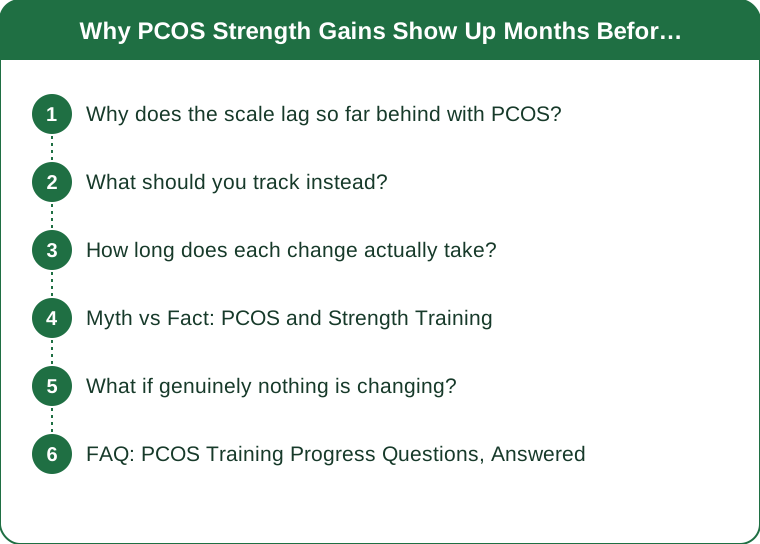
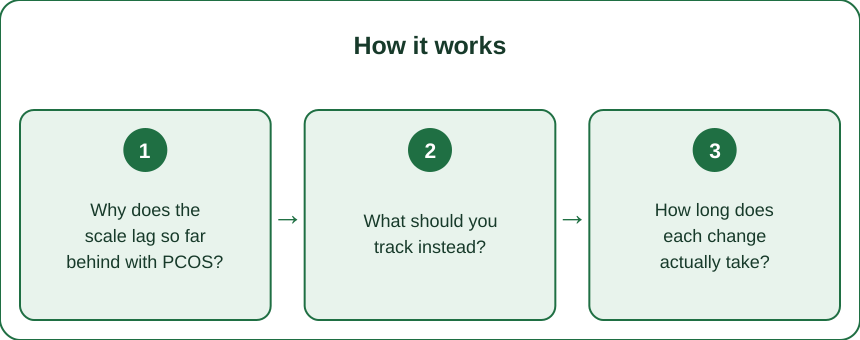
Why does the scale lag so far behind with PCOS?
Three things are happening at once, and they partly cancel out on a bathroom scale.
You are adding muscle while losing fat. In the first few months of consistent resistance training — especially for someone newer to lifting — these can run close enough in magnitude that net weight barely moves. The composition underneath has changed substantially.
Muscle holds water, particularly early on. New training increases stored muscle glycogen, and glycogen binds water at roughly three grams of water per gram of glycogen. That shows up as a couple of pounds that are not fat and are not a problem.
Insulin sensitivity improves before weight does. This is the important one. Resistance training increases glucose uptake into muscle through a pathway that does not depend on insulin, and it does so within weeks. That metabolic improvement is the actual goal in PCOS management, and the scale has no way to display it.
So the scale is not lying. It is answering a question you did not need the answer to.
What should you track instead?
Five markers, all of which move earlier and mean more.
- Your working weights. The most direct evidence the training is doing what it is supposed to. If your squat, row, or press has gone up over eight weeks, the stimulus is real.
- Waist measurement, not weight. Visceral fat around the middle is the deposit most associated with insulin resistance in PCOS, and it is often the first to shift. Measure at the navel, same time of day, once every two weeks.
- Cycle regularity. For many people this is the most meaningful signal there is, and it typically responds within three to six months of consistent training. Track cycle length even if it is irregular.
- Energy and post-meal crashes. A reduction in the heavy, sleepy feeling after carbohydrate-containing meals is a practical, felt sign of improving insulin sensitivity.
- How clothes fit at the waist specifically. More sensitive than the scale, and free.
Weigh yourself if you want, but demote it. Put it fifth on the list, not first.
How long does each change actually take?
Rough timelines help enormously with patience, because unrealistic expectations are what cause people to quit at week ten.
- Weeks 1-3: neural gains. Your weights go up quickly and you have not built much muscle yet. This is real progress in coordination and recruitment, and it is the reason early increases feel dramatic.
- Weeks 4-8: insulin sensitivity. Measurable improvements in glucose handling appear in this window with consistent training. You often feel it before anything is visible.
- Weeks 8-16: body composition. Waist measurement starts moving. Clothes fit differently. The scale still may not budge.
- Months 3-6: cycle changes. If cycles are going to regularize with lifestyle change, this is typically when it starts.
- Months 6-12: visible weight change. For many people this is when the scale finally reflects what has been happening all along.
The order matters more than the dates. If you expect weight first, you will conclude it is failing during the exact months it is working.

Myth vs Fact: PCOS and Strength Training
Myth: Cardio is better for PCOS weight loss. Fact: Cardio has real benefits, but resistance training is uniquely good at building the muscle that acts as a glucose sink, which addresses the insulin resistance underlying many PCOS symptoms. Most guidance favors doing both, with strength training as a non-negotiable rather than an optional extra.
Myth: Lifting will make you bulky, which is worse with PCOS hormones. Fact: Meaningful muscle gain is slow and requires deliberate effort in surplus. What most people experience is a firmer, smaller waist. The androgen levels associated with PCOS do not turn a twice-weekly lifting habit into rapid mass gain.
Myth: If the scale has not moved in 12 weeks, the program is wrong. Fact: Twelve weeks is squarely inside the window where composition changes without weight changes. Judge the program on strength, waist, and energy at 12 weeks; judge it on weight at six months.
Myth: You need to train hard and often for it to count. Fact: Two to three sessions a week of proper resistance training produces most of the metabolic benefit. High-frequency, high-intensity training raises cortisol and often backfires — a pattern many people with PCOS notice clearly.
What if genuinely nothing is changing?
It is worth taking seriously rather than just training harder.
Check that you are actually progressing the load. Doing the same weights for 12 weeks is maintenance, not a training stimulus. If the numbers in your log are flat, that is the problem, and it is fixable in one session.
Check protein intake. Building muscle in a modest deficit requires adequate protein — commonly cited targets are around 0.7-1.0 grams per pound of target body weight. Under-eating protein is the most common reason a good program produces nothing.
Check that you are recovering. PCOS is often accompanied by disrupted sleep, and lifting on chronic sleep debt produces poor results. Two solid sessions with good sleep beat five poor ones.
Check for a thyroid issue or other contributor. Hypothyroidism frequently coexists with PCOS and produces exactly this picture — effort without response. This is worth a conversation with your doctor rather than a training change.
This is general information, not medical advice. If nothing has moved across six months of genuinely consistent training and adequate nutrition, that is a reason to see a professional rather than to add more sessions.
FAQ: PCOS Training Progress Questions, Answered
Should I stop weighing myself entirely?
Not necessarily — some people find data reassuring. What helps is changing the frequency and the interpretation: weigh weekly at most, look only at the four-week trend, and never at a single reading. If the number consistently derails your week, stopping is a completely reasonable choice.
Is it normal for weight to go up at first?
Yes, and it is common. Increased muscle glycogen and the water bound to it can add a few pounds in the first two to four weeks of a new program. It is not fat, and it stabilizes. This is exactly the window where people quit, which is unfortunate given what follows.
How many days a week should I lift with PCOS?
Two to three full-body sessions a week is the sweet spot for most people — enough stimulus for real gains, and low enough total stress that it does not aggravate the cortisol and recovery issues many people with PCOS already contend with. Add walking on other days rather than more lifting.
TL;DR:
- With PCOS, insulin sensitivity and body composition improve months before body weight does.
- Track working weights, waist measurement, cycle regularity, and post-meal energy — the scale goes last.
- Expect neural gains in weeks 1-3, metabolic change by week 8, waist change by week 16, and weight change closer to six months.
- Two to three full-body sessions a week beats high-frequency training for most people with PCOS.
- If nothing moves in six months of genuine consistency, check protein, sleep, load progression, and thyroid — then talk to your doctor.
The training that is not showing up on the scale at week twelve is very often the training that will show up on it at month eight. The mistake is quitting in between.
Keep Reading
This article is for general informational purposes only and is not medical advice. Always consult a qualified health professional for guidance specific to you.