Why PCOS Symptoms Change When the Seasons Do
Quick Answer: Seasonal symptom shifts in PCOS are mostly driven by three things changing together: light exposure, which affects circadian timing and therefore insulin sensitivity; vitamin D status, which is commonly lower in PCOS and drops further in winter; and activity and eating pattern changes that follow darker evenings. The practical levers are morning light within an hour of waking, keeping movement volume steady across seasons, and reviewing vitamin D with your doctor in autumn rather than midwinter. This is general information, not medical advice.
Your cycle was reasonably predictable in July.
By late October it is doing something else entirely, your afternoon crash has moved to 2pm, and nothing about your routine feels different.
Quite a lot changed. Just none of it deliberately.
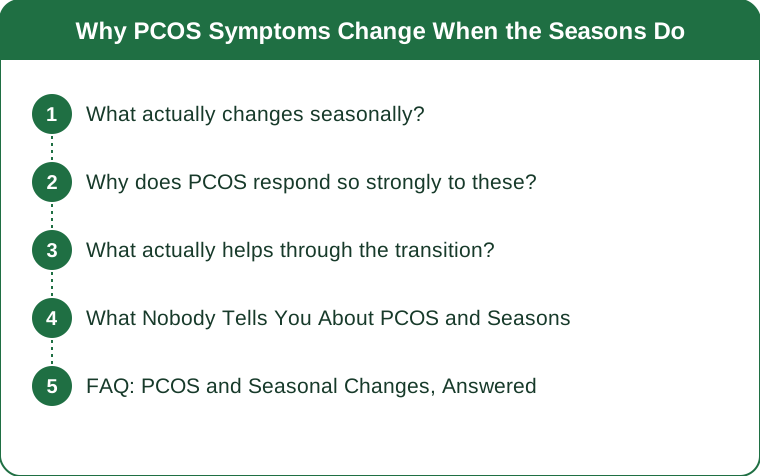
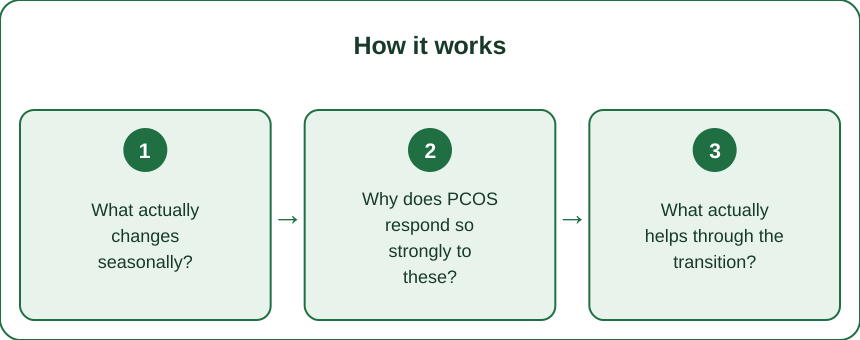
What actually changes seasonally?
Four inputs shift at roughly the same time, and PCOS is sensitive to all four.
Light exposure falls sharply. At mid-latitudes, daily light exposure drops enormously between August and November, and morning light is the primary signal setting circadian timing. Circadian disruption reduces insulin sensitivity, which is the central mechanism in PCOS for many people.
Vitamin D status declines. Vitamin D insufficiency is more common in PCOS than in the general population, and skin synthesis effectively stops in winter at higher latitudes. It has been associated with insulin resistance and cycle regularity, although the evidence on supplementation outcomes is mixed.
Activity volume drops without a decision. Incidental walking, outdoor time and general daily movement all fall in autumn. For many people this is a larger change than their formal training, and it is invisible because no workout was skipped.
Eating pattern shifts. Cooler weather, earlier darkness and social season changes reliably move both meal timing and composition, and later eating is associated with poorer glucose handling.
Sleep timing drifts. Darker mornings delay wake time and reduce sleep regularity, and sleep irregularity has a measurable relationship with insulin sensitivity.
Stress load often rises too. The autumn return to a busier schedule is real, and cortisol interacts with everything above.
Why does PCOS respond so strongly to these?
Because the common thread is insulin, and PCOS amplifies insulin-related changes.
Insulin sensitivity has a daily rhythm. It is higher in the morning and lower in the evening for most people. Anything that delays circadian timing pushes eating into the less favourable window.
Circadian disruption reduces insulin sensitivity directly. This is well established in shift-work research, and seasonal light change is a milder version of the same input.
Reduced activity compounds it. Muscle contraction moves glucose independently of insulin, so a drop in daily walking removes a genuinely significant glucose-clearing mechanism.
Sleep loss raises insulin resistance measurably. Even modest sleep restriction has demonstrable effects, and autumn sleep is often more fragmented and less regular.
Symptoms are downstream, not the problem itself. Cycle irregularity, energy crashes and cravings are what you notice. The upstream variables are light, movement, sleep and eating timing.
Which is genuinely good news. All four upstream inputs are things you can adjust, and none of them require a new diagnosis or a new medication.
What actually helps through the transition?
Front-load light and protect movement volume. Those two carry most of the effect.
Get outside within an hour of waking. 10 to 20 minutes of outdoor morning light, even on an overcast day, is far brighter than indoor lighting and is the strongest available circadian signal.
Keep step count, not just workouts. Track total daily movement through the transition. Most people lose 1,500 to 3,000 steps a day in autumn without noticing, and that is a meaningful glucose-handling loss.
Protect the post-meal walk. 10 minutes after your largest meal remains one of the highest-return, lowest-effort interventions, and it is the first thing dropped when evenings get dark and cold. Move it indoors rather than abandoning it.
Anchor wake time before bedtime. A consistent wake time does more for circadian stability than a consistent bedtime, and darker mornings make it harder.
Review vitamin D in early autumn, not February. Testing and correcting in September or October is more useful than discovering a deficiency at the end of winter. Discuss dosing with your doctor rather than self-prescribing high doses.
Move strength training earlier if energy allows. If your afternoon crash is deepening, an earlier session often preserves training quality better than pushing through at 6pm.
What Nobody Tells You About PCOS and Seasons
Cycle length variation often widens in autumn, then settles. Many people find that the transition months are less predictable than either summer or deep winter. The instability is in the change, not the season itself.
Afternoon cravings are frequently a light and sleep signal, not a willpower one. They commonly track sleep regularity more closely than they track what you ate at lunch.
Indoor lighting is not a substitute. A bright office is typically a small fraction of the intensity of an overcast outdoor morning. Your body is not being fooled.
The activity drop is invisible because workouts stay constant. People maintain three gym sessions a week and lose thousands of daily steps, then conclude that training stopped working.
Warmth changes appetite genuinely. Cold exposure increases energy intake for most people, so autumn appetite changes are a physiological effect rather than a personal failing.
And the useful one: because these inputs are seasonal and predictable, they can be planned for. Deciding in August what your October morning light and post-meal walk will look like works far better than reacting in November.
FAQ: PCOS and Seasonal Changes, Answered
Is it normal for PCOS cycles to change with the season?
Many people report it, and the plausible mechanisms are well documented. Persistent or dramatic changes are still worth discussing with your doctor.
Should I take vitamin D?
Test first and follow medical advice on dosing. Deficiency is more common in PCOS, but self-prescribed high doses are not a good idea.
Does a light therapy lamp help?
Outdoor morning light is the first choice. A lamp is a reasonable option where mornings are genuinely dark, used consistently and early in the day.
Why do my afternoon crashes get worse in autumn?
The combination of shifted sleep timing, less morning light and reduced daily movement all push in the same direction.
Should I change my training in winter?
Keep the volume, adjust the timing. The bigger risk is losing incidental daily movement, not losing workouts.
When should I see a doctor?
If cycles stop entirely, change dramatically, or if new symptoms appear. Seasonal variation should be a modest shift, not a transformation. This is general information, not medical advice.
TL;DR:
- Autumn changes light exposure, vitamin D, daily movement, sleep timing and eating pattern all at once.
- The common pathway is insulin sensitivity, which PCOS amplifies.
- Get 10 to 20 minutes of outdoor light within an hour of waking.
- Protect total daily steps and the 10-minute post-meal walk, indoors if needed.
- Review vitamin D in early autumn with your doctor, not in February.
Pick the morning light one and hold it for three weeks. It is the single input that moves the most others.
Keep Reading
This article is for general informational purposes only and is not medical advice. Always consult a qualified health professional for guidance specific to you.