Why PCOS Workouts Feel Harder on Some Days for No Obvious Reason
Quick Answer: PCOS involves less predictable hormonal fluctuation than a typical menstrual cycle, meaning insulin sensitivity, cortisol, and energy-regulating hormones can shift meaningfully day to day rather than following an easily anticipated monthly pattern — which is why identical workouts can feel disproportionately harder on some days without an obvious external cause like sleep or nutrition explaining it.
It’s not inconsistent effort and it’s not imagined. With PCOS specifically, the hormonal backdrop to any given workout is genuinely less predictable than the standard cycle-based advice assumes.

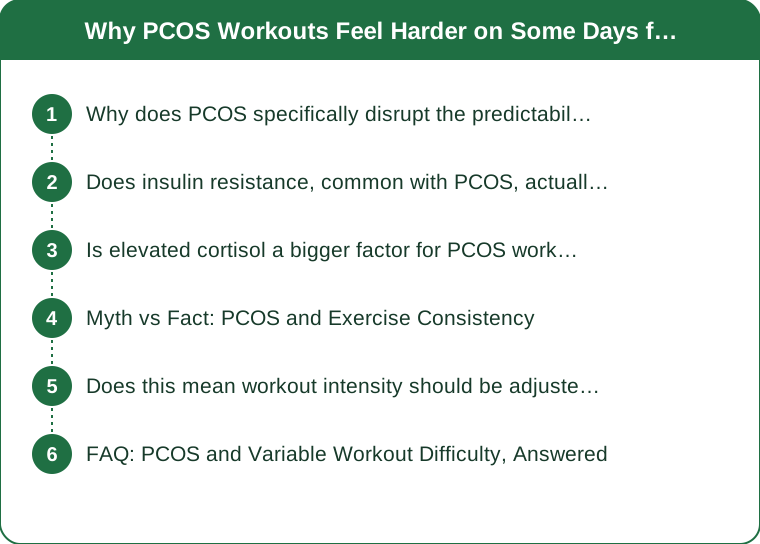
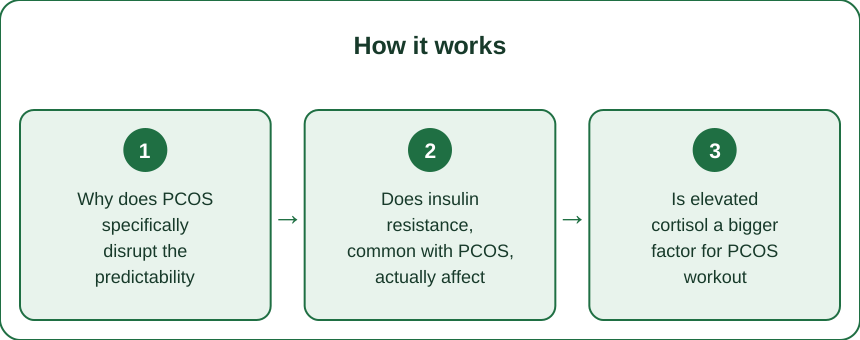
Why does PCOS specifically disrupt the predictability that typical cycle-based workout advice assumes?
Most exercise-and-cycle guidance is built around a fairly regular ovulatory pattern with predictable hormone shifts, but PCOS commonly involves irregular or absent ovulation, meaning the hormonal fluctuations that do occur don’t follow the same reliable monthly timeline, making day-to-day energy and workout difficulty considerably harder to predict in advance.
Does insulin resistance, common with PCOS, actually affect workout performance directly?
Yes — insulin resistance affects how efficiently muscles can access and use glucose for fuel, and since insulin sensitivity itself can fluctuate somewhat day to day even within the same person, a day with relatively lower insulin sensitivity can make the same workout intensity feel measurably harder despite identical training load and apparent effort.
Is elevated cortisol a bigger factor for PCOS workout variability than for people without PCOS?
PCOS is associated with higher baseline stress-hormone sensitivity in some research, meaning normal daily stressors can produce a comparatively larger cortisol response, which independently affects perceived exertion and available energy for a workout on a given day beyond what sleep or diet alone would explain.

Myth vs Fact: PCOS and Exercise Consistency
Myth: feeling inconsistent difficulty on similar workouts means training isn’t working or effort is lacking. Fact: day-to-day hormonal variability is a well-documented, real feature of PCOS specifically, and tracking overall trends over weeks — not judging any single hard day — is a more accurate way to assess actual progress.
Does this mean workout intensity should be adjusted day to day rather than following a fixed plan?
Many PCOS-focused training approaches do recommend a degree of flexible intensity — sticking to consistent workout frequency and type while allowing intensity or load to flex somewhat on unusually hard days tends to support better long-term adherence than rigidly pushing through every session at a fixed target.
FAQ: PCOS and Variable Workout Difficulty, Answered
Should a harder-than-usual workout day be pushed through anyway?
Moderate flexibility (scaling intensity down rather than skipping entirely) is often a more sustainable approach than either always pushing through or always skipping, though individual medical guidance should take priority.
Does tracking cycle symptoms help even without a regular cycle?
Yes — even irregular symptom tracking (energy, sleep, mood) over time can reveal personal patterns useful for anticipating harder days, even without a predictable cycle-length pattern to rely on.
Is strength training or cardio generally better tolerated on variable-energy days with PCOS?
This varies by individual, though some research on PCOS specifically favors strength training for its insulin-sensitivity benefits, with cardio intensity flexed more freely based on daily energy.
This is general information, not medical advice — PCOS symptoms and appropriate exercise intensity should be discussed with a healthcare provider familiar with your specific case.
TL;DR:
- PCOS involves less predictable hormonal fluctuation than a typical cycle, making workout difficulty harder to anticipate
- Day-to-day insulin sensitivity shifts can directly affect how hard an identical workout feels
- Higher stress-hormone sensitivity associated with PCOS adds another source of daily variability beyond sleep or diet
- Tracking trends over weeks, and allowing some flexible intensity, works better than judging any single hard day
A harder-than-usual workout day with PCOS usually isn’t a sign anything’s wrong — it’s a real hormonal variability the standard cycle-based advice doesn’t fully account for.
Keep Reading
This article is for general informational purposes only and is not medical advice. Always consult a qualified health professional for guidance specific to you.