Why PCOS Workouts Feel Harder Some Days for No Obvious Reason
Quick Answer: PCOS involves irregular hormone fluctuations (insulin, androgens, and often less predictable cycle-related hormone shifts) that can affect energy availability and perceived exertion day to day in a way that’s less predictable than a typical menstrual cycle pattern. Tracking symptoms alongside workouts over several weeks often reveals a personal pattern worth adjusting training around.
If your workouts feel randomly harder some days despite identical effort and routine, that unpredictability is a real, documented pattern with PCOS — not inconsistent effort or a mental block.

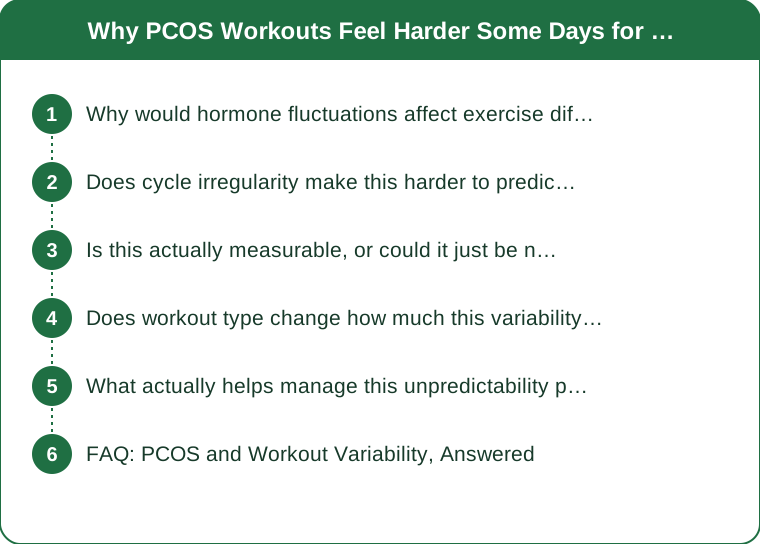
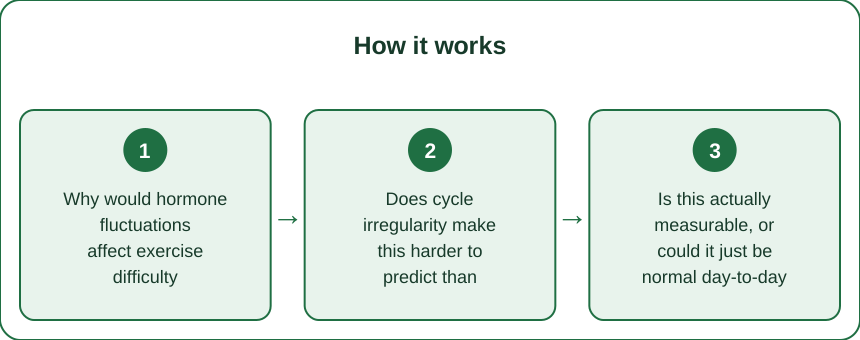
Why would hormone fluctuations affect exercise difficulty specifically?
Insulin resistance, common in PCOS, can affect how efficiently muscles access and use glucose for energy during exercise, and this efficiency can vary day to day depending on recent food intake, sleep, and stress — all of which interact with insulin sensitivity. This creates a less predictable energy availability pattern than in someone without insulin resistance.
Does cycle irregularity make this harder to predict than typical cycle-based fatigue?
Yes, notably — many people with PCOS have irregular or unpredictable cycles, which removes the more familiar ‘harder in the days before a period’ pattern that cycle-tracking exercisers without PCOS can often plan around. This unpredictability is part of why the difficulty feels more random rather than following an obvious pattern.
Is this actually measurable, or could it just be normal day-to-day variation everyone has?
Both are real — everyone has some day-to-day exercise variability from sleep and stress, but research on PCOS and exercise response suggests the degree of variability tends to be somewhat greater, particularly tied to insulin sensitivity fluctuations, which isn’t a factor for people without insulin resistance.

Does workout type change how much this variability shows up?
It can — high-intensity efforts that rely heavily on rapid glucose availability may be more affected by an insulin-resistant day than steadier, moderate-intensity efforts, which is part of why some people with PCOS report needing more flexibility in workout intensity than a fixed weekly plan allows for.
What actually helps manage this unpredictability practically?
Building some flexibility into a weekly plan (a flexible ‘hard day’ that can shift based on how the body feels) rather than a rigid fixed schedule, along with tracking sleep, stress, and how workouts felt over several weeks, helps many people identify their own personal pattern rather than experiencing it as fully random.
FAQ: PCOS and Workout Variability, Answered
Does this mean strength training is a bad idea with PCOS?
No — strength training is commonly recommended for PCOS management specifically; the variability discussed here is about day-to-day intensity feel, not a reason to avoid a training type altogether.
Should you push through a harder-than-expected day or scale back?
Many people find scaling back intensity on a noticeably harder day, rather than pushing through, works better long-term — check with a doctor or trainer familiar with PCOS for personalized guidance.
Does nutrition timing around workouts matter more with PCOS?
Many with PCOS find that stable, balanced meals with protein and fiber before a workout help smooth out some of this variability, though individual response varies.
This is general information, not medical advice — work with a doctor or PCOS-informed trainer to build an approach suited to your specific symptoms.
TL;DR:
- PCOS-related insulin resistance can create day-to-day variability in exercise energy availability
- Irregular cycles remove the more predictable fatigue pattern others plan cycle-based training around
- High-intensity efforts may be more affected by variability than steady moderate efforts
- Flexible scheduling and tracking symptoms over weeks helps reveal a personal pattern
The unpredictability isn’t a discipline problem — it’s a documented part of PCOS, and flexible training plans work with it better than rigid ones.
Keep Reading
This article is for general informational purposes only and is not medical advice. Always consult a qualified health professional for guidance specific to you.