Why Workout Recovery Takes Longer With PCOS - and How to Train Around It
Quick Answer: Several features common in PCOS - low-grade chronic inflammation, insulin resistance affecting how quickly muscle refills glycogen, disrupted sleep, and altered cortisol patterns - all slow recovery between sessions. The training does not need to be easier; the spacing and the fueling need to be different. The practical shift: 48 hours between hard sessions rather than 24, protein and carbohydrate within about two hours after training, and strength work prioritized over repeated high-intensity cardio.
This is a recovery-capacity issue, not an effort issue.
And it responds well once the schedule matches the physiology. This is general information, not medical advice.

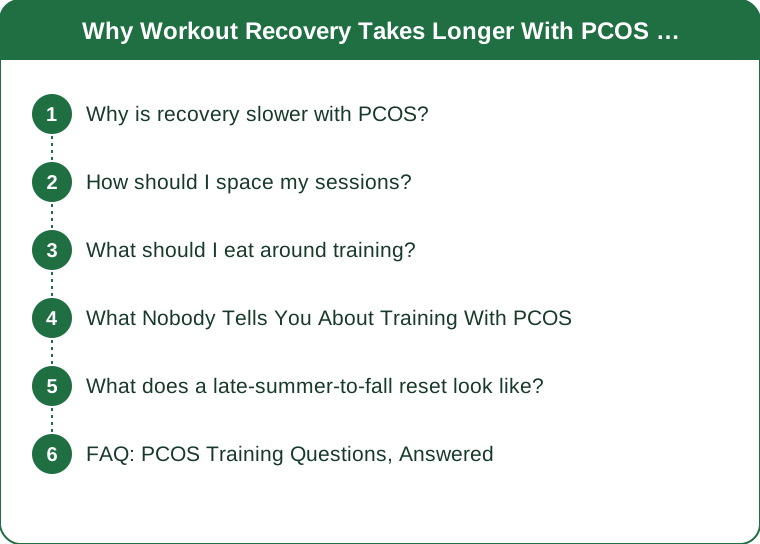
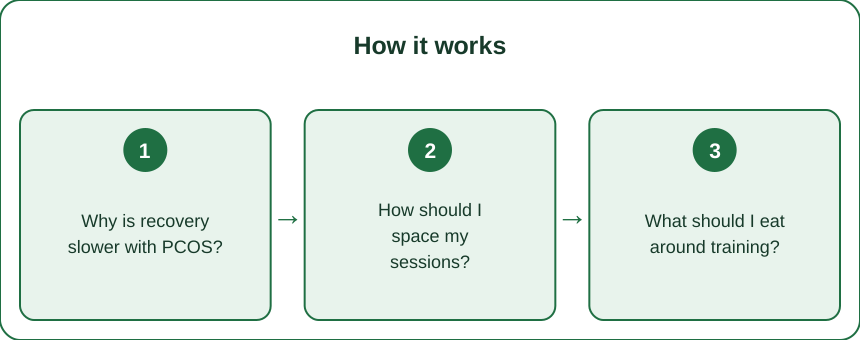
Why is recovery slower with PCOS?
Four mechanisms, and most people have more than one.
Low-grade chronic inflammation. PCOS is frequently associated with elevated inflammatory markers. Post-exercise repair relies on a controlled inflammatory response, and starting from an already-elevated baseline means the return to normal takes longer.
Insulin resistance and glycogen refilling. Insulin drives glucose into muscle. When cells respond less readily, muscle glycogen refills more slowly after training - so the next session starts from a partly depleted tank, which feels exactly like being unfit.
Sleep disruption. Sleep problems, including a notably higher rate of obstructive sleep apnea, are common in PCOS. Most tissue repair and growth hormone release happen during deep sleep, so fragmented sleep directly reduces overnight recovery.
Altered cortisol handling. Cortisol responses to stress can differ in PCOS, and elevated cortisol works against muscle repair while pushing insulin resistance further - a loop where hard training makes the underlying issue worse rather than better.
The practical consequence: the same training program that works well for someone else may be spaced too tightly for you. The problem is the interval, not the workout.
How should I space my sessions?
Longer gaps, and the gaps are the intervention rather than a compromise.
48 hours between hard sessions, not 24. Strength work Monday and Thursday beats Monday and Tuesday, even if the total volume is identical. The adaptation happens during the gap.
A workable weekly structure:
- 2-3 strength sessions, non-consecutive.
- 2-3 easy movement days - walking, easy cycling, mobility. These help rather than hinder, because low-intensity movement improves insulin sensitivity without adding recovery debt.
- At most one genuinely hard cardio session, and only if the strength sessions are going well.
- One full rest day.
Why strength gets priority: resistance training increases muscle mass, and muscle is the largest site of glucose disposal in the body. The insulin-sensitivity benefit of strength training is structural and lasting, whereas the benefit of a single cardio session largely fades within a couple of days.
Why repeated high-intensity cardio backfires: it is the highest-cortisol, highest-recovery-cost option available. A little is valuable; frequent sessions on insufficient recovery tend to make symptoms worse, which is the pattern behind a lot of frustrating training histories.
What should I eat around training?
This is where the biggest single improvement usually comes from.
Do not train fasted. Fasted training raises cortisol more than fed training, and with PCOS that is the wrong direction. Something small beforehand is enough - it does not need to be a meal.
Eat protein and carbohydrate within about two hours after. Roughly 20-30 g of protein plus a real carbohydrate source. The carbohydrate is not optional - it is what refills glycogen, and post-exercise is the window where muscle takes up glucose most readily even with insulin resistance. Skipping carbs after training is one of the most common self-defeating choices here.
Total protein across the day matters more than timing. Aim for a consistent amount at each meal rather than most of it at dinner. Protein also improves satiety, which matters given how commonly appetite regulation is disrupted in PCOS.
Pair carbohydrate with protein, fat, or fiber at other meals. It blunts the glucose response substantially.
And a ten-minute walk after meals is one of the highest-return habits available - it meaningfully reduces post-meal glucose with almost no recovery cost.

What Nobody Tells You About Training With PCOS
Five things that reframe the whole experience.
Progress shows up in strength before it shows up on the scale, and often long before. Body composition can improve substantially while weight stays flat, and with PCOS this disconnect is especially common. Track the weight on the bar and how clothes fit; the scale is the least informative measure you have.
Day-to-day variation is larger than average, and it is not random. Sleep, cycle phase, stress, and the previous session all stack. A workout that felt easy in one week and brutal the next is normal here, and it is not a sign of lost fitness.
More is reliably worse past a certain point. The instinct when progress stalls is to add sessions. With a recovery-limited condition, adding volume to an unrecovered system makes everything worse - the fix is nearly always more space, more food, or more sleep.
Sleep is a training variable, not a lifestyle one. Improving sleep frequently does more for training progress than changing the program, particularly if snoring or unrefreshing sleep is part of the picture - that is worth raising with a doctor.
Consistency across months beats intensity across weeks. Insulin sensitivity improvements come from regular training sustained over time. Three sessions a week for a year beats six sessions a week for six weeks, every time.
What does a late-summer-to-fall reset look like?
The seasonal change is a genuinely good moment to restructure, and for specific reasons.
Schedules stabilize. School and work routines firm up after Labor Day, which makes fixed training days realistic in a way summer rarely allows. Fixed days beat flexible intentions when recovery spacing is the whole point.
Cooler weather lowers the cost of easy outdoor movement. Walking becomes pleasant again, and the post-meal walk habit is far easier to build in September than in a humid August.
Daylight loss affects sleep timing. As mornings get darker, sleep onset and wake time drift. Getting light exposure early in the day helps hold the rhythm - and given how central sleep is here, it is worth protecting deliberately.
Set the schedule for the whole fall now, with the gaps built in. Two strength days, a walking habit, one optional harder session. Write down the rest days as commitments rather than as leftovers - they are the part that gets abandoned first and matters most.
And give any change 8-12 weeks before evaluating. Metabolic and hormonal adaptations move on that timescale, not on a two-week one.
FAQ: PCOS Training Questions, Answered
Is HIIT bad for PCOS?
Not inherently - short high-intensity work has real benefits for insulin sensitivity. The problem is frequency. Once a week alongside strength work is reasonable; four times a week on limited recovery tends to backfire.
Why am I sore for three or four days?
Extended soreness is consistent with a slower inflammatory resolution and slower glycogen refilling. Check whether you are eating enough carbohydrate after training - underfueling is a very common contributor and an easy thing to correct first.
Should I train differently at different points in my cycle?
Many people find it helpful, though cycles are often irregular with PCOS, which makes planning around them difficult. A more practical approach is to autoregulate: go by how the warm-up feels rather than by a calendar.
TL;DR:
- Recovery is slower for structural reasons - inflammation, insulin resistance, sleep disruption, and cortisol patterns.
- Space hard sessions 48 hours apart. The gap is the intervention, not a concession.
- Prioritize strength over frequent high-intensity cardio - muscle is the largest site of glucose disposal.
- Eat protein and carbohydrate within about two hours after training. Skipping post-workout carbs backfires.
- Treat sleep as a training variable, and give any change 8-12 weeks before judging it.
Pick the spacing change first. It costs nothing, it is the fastest thing to test, and for most people it is the one that makes the next session finally feel better than the last. This is general information, not medical advice - talk to your doctor about your own situation.
Keep Reading
This article is for general informational purposes only and is not medical advice. Always consult a qualified health professional for guidance specific to you.